

Introduction
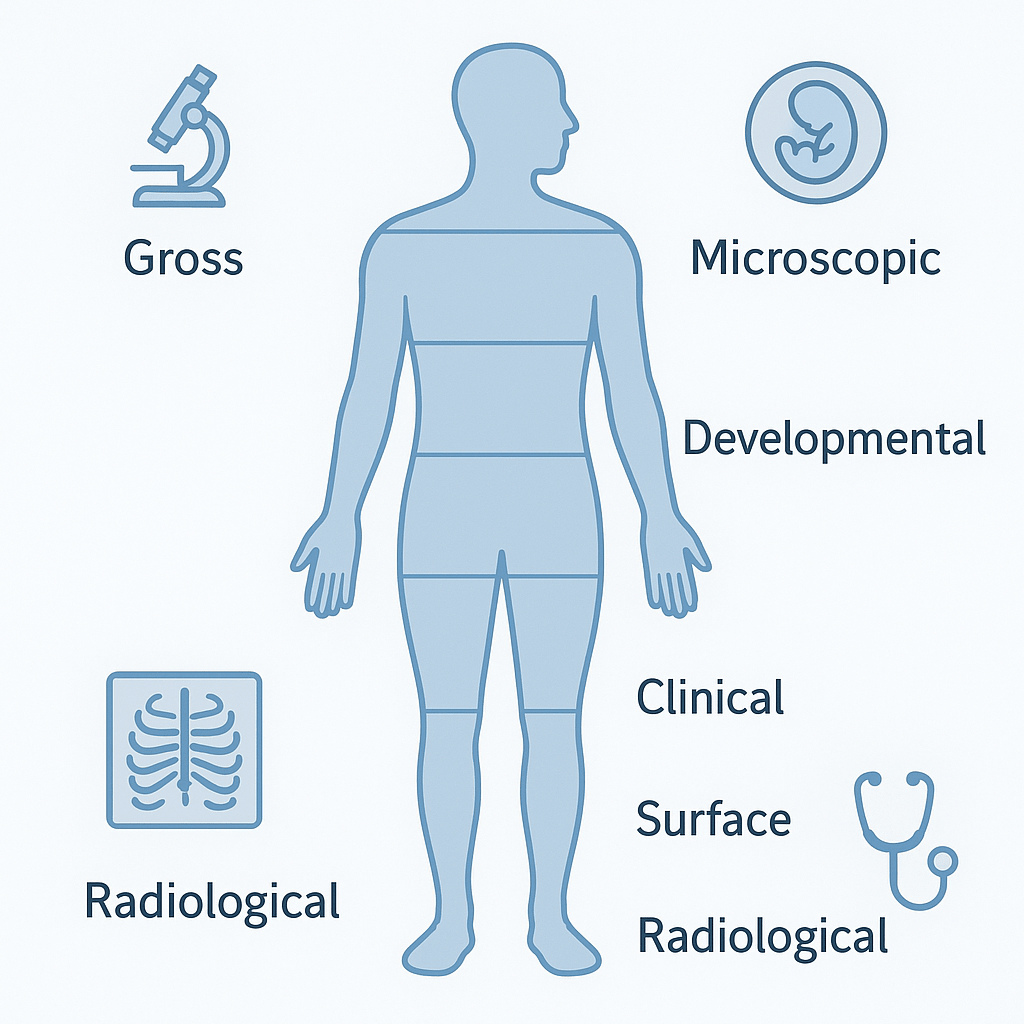
Anatomy is one of the cornerstones of medical science, offering a clear understanding of the body’s structure and function. For first-year MBBS students and healthcare professionals, knowing the different types of anatomy is vital. Each branch provides unique insights, from the visible organs and tissues to microscopic cells and advanced medical imaging.
In this guide, we’ll walk through the seven major types of anatomy, their significance, and why mastering them is essential for every medical learner.
1. Gross Anatomy (Macroscopic Anatomy)
Gross anatomy, also known as macroscopic anatomy, involves studying structures visible to the naked eye—such as bones, muscles, and organs.
- Approaches in gross anatomy:
- Regional anatomy: Focuses on specific regions of the body like the head, thorax, or abdomen.
- Systemic anatomy: Examines entire organ systems such as the cardiovascular, respiratory, or nervous systems.
- Regional anatomy: Focuses on specific regions of the body like the head, thorax, or abdomen.
👉 Why it matters: Gross anatomy is fundamental for dissection practices, surgical training, and clinical diagnosis.
2. Microscopic Anatomy (Histology)
Microscopic anatomy dives deeper, exploring tissues and cells under a microscope.
- Histology: Study of tissues and how they function together.
- Cytology: Study of individual cells.
👉 Why it matters: It helps pathologists, researchers, and clinicians understand diseases at the cellular level and detect abnormalities.
3. Developmental Anatomy (Embryology)
Developmental anatomy examines how an organism grows from conception through adulthood.
- Embryology: Focuses on the development of the embryo in the womb.
👉 Why it matters: It is essential for understanding congenital disorders, pregnancy management, and pediatric medicine.
4. Comparative Anatomy
Comparative anatomy studies similarities and differences in structure across species.
👉 Why it matters: This branch is crucial in evolutionary biology, explaining adaptations and aiding in research through animal models that provide insights into human health.
5. Clinical Anatomy (Applied Anatomy)
Clinical anatomy directly applies anatomical knowledge to medical practice.
- Examples include:
- Identifying safe injection sites.
- Locating blood vessels during surgery.
- Identifying safe injection sites.
👉 Why it matters: It bridges theoretical knowledge with practical use, supporting diagnosis, treatment, and surgical precision.
6. Surface Anatomy
Surface anatomy studies the external form of the body and its relationship to deeper internal structures.
- Applications:
- Physical examinations.
- Recognizing body landmarks such as ribs, muscles, and pulse points.
- Physical examinations.
👉 Why it matters: It enables non-invasive examination and helps clinicians assess a patient quickly.
7. Radiological Anatomy (Imaging Anatomy)
Radiological anatomy focuses on interpreting body structures through imaging techniques.
- Tools used: X-rays, CT scans, MRI, and ultrasound.
👉 Why it matters: Imaging is now central to modern medicine, allowing accurate diagnosis and guiding minimally invasive treatments.
Summary Table of the 7 Types of Anatomy
| Type of Anatomy | Focus Area | Importance in Medicine |
| Gross Anatomy | Organs, muscles, bones (visible) | Surgery & dissection |
| Microscopic Anatomy | Cells & tissues (microscopic) | Pathology & research |
| Developmental Anatomy | Growth & embryology | Pediatrics & obstetrics |
| Comparative Anatomy | Structural comparison across species | Evolution & research |
| Clinical Anatomy | Applied medical knowledge | Diagnosis & treatment |
| Surface Anatomy | External landmarks | Physical examination |
| Radiological Anatomy | Imaging & scans | Diagnosis & radiology |
Conclusion
The seven types of anatomy—Gross, Microscopic, Developmental, Comparative, Clinical, Surface, and Radiological—form the backbone of medical education. For MBBS students, understanding these branches not only helps in exams but also builds the foundation for clinical practice and specialization.
👉 Remember, anatomy isn’t just about memorizing names and diagrams. It’s about connecting the structure of the human body to its functions in real-life medicine.
❓ Frequently Asked Questions (FAQs)
1. What are the 7 main types of anatomy?
The seven types of anatomy are Gross Anatomy, Microscopic Anatomy, Developmental Anatomy, Comparative Anatomy, Clinical Anatomy, Surface Anatomy, and Radiological Anatomy.
2. What is the difference between gross anatomy and microscopic anatomy?
Gross anatomy studies visible body structures like bones and organs, while microscopic anatomy focuses on cells and tissues that require a microscope.
3. Why is anatomy important in medicine?
Anatomy provides the foundation for understanding the human body, which is crucial for diagnosis, surgery, radiology, and medical research.
4. What is clinical anatomy used for?
Clinical anatomy is applied in patient care—for example, identifying safe injection sites, guiding surgical procedures, or interpreting medical images.
5. Which type of anatomy do MBBS students study first?
Most medical students begin with Gross Anatomy through dissections and models, then move on to microscopic and clinical anatomy.
6. How is radiological anatomy different from surface anatomy?
Radiological anatomy uses imaging tools like CT and MRI to see inside the body, while surface anatomy examines external landmarks during physical exams.
7. What books are best for learning anatomy in MBBS 1st year?
Recommended books include Gray’s Anatomy, Netter’s Atlas of Human Anatomy, and Snell’s Clinical Anatomy.

 Help Line :
  WhatsApp Us :
  Mail Us :